


The truck is already there, which is exactly why the question comes up
Canadian warehouses spend late summer on the maintenance that cannot happen when the building is busy, and most of it is overhead. A forklift work platform turns the lift truck already sitting in the aisle into a way of reaching those lights, sprinklers, and racking beams.
It is also the point where a machine designed around one job is asked to do another. Everything about a lift truck assumes the load is a pallet that does not mind being tipped, dropped, or shaken, and none of those assumptions survive once a person is standing on it.
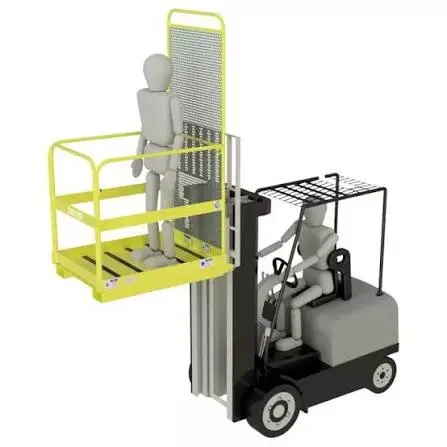
Can a forklift lift a person, and under what conditions
The answer in Canada is yes, but only with an approved platform and only under specific conditions. Provincial occupational health and safety regulations treat this as elevating a worker rather than handling a load, and they set out what the platform must have and how the truck must be operated.
The common thread across jurisdictions is that improvisation is prohibited. A pallet, a bin, or a deck somebody welded up in the shop does not qualify, and the reason is that none of them address the failure modes a purpose built unit is designed around.
The locking mechanism answers the failure everyone forgets
Forks are smooth steel bars, and anything resting on them slides when the mast tilts forward. A platform that is merely sitting in place will move, and the movement people picture as gradual is closer to sudden once the friction is broken.
A locking device ties the deck to the carriage so it cannot shift or come off the fork tips. Fitting it takes seconds, and it is the step most often skipped by somebody who is only going up for a minute to change a lamp.
The cage is for the person, not for the platform
Guardrails and mesh sides exist because a fall from four meters is the hazard, not the structure failing. The mesh also stops tools and parts from dropping onto whoever is standing below, which on a busy floor is the more likely incident of the two.
Toe boards do the same job at deck level. A wrench sliding off the edge reaches the ground with enough energy to matter, and the low lip around the perimeter is doing considerably more work than its size suggests.
A harness is required more often than people assume
Several provinces require fall protection in addition to the enclosure, anchored to a point on the platform rather than to the mast or the racking. The logic is that guardrails stop a person falling out while standing, and do less for somebody reaching over the rail.
The anchor point matters as much as the harness. Tying off to the building means a person is attached to something the truck can move away from, which converts a fall hazard into a considerably worse one, so the connection stays on the equipment carrying them.
The capacity figure includes everything that goes up
An 880 pound forklift work platform is rated for the total of the deck, the people on it, and the tools, materials, and parts they take with them. Two workers plus a box of fittings reaches that number faster than most people estimate before loading.
The truck itself also has to be checked. Lift trucks lose capacity as the mast rises and again if the load sits forward of the fork face, so the rating on the data plate at full height is the number that governs, not the one printed on the front of the machine.
The operator stays in the seat, and the truck stays still
A raised platform means the driver does not leave the controls while anyone is up there. Traveling with a person elevated is prohibited, and repositioning means bringing the deck down, moving, and lifting again rather than nudging the truck along the aisle.
This is where forklift work platform safety usually breaks down in practice. Nobody plans to drive with somebody in the air, and it happens because moving two meters seemed easier than the full cycle of lowering, repositioning, and raising again.
Two people are doing the job and only one can see all of it
The person on the deck can see the work and not the floor, while the operator can see the floor and not the work. Agreeing on hand signals before anything rises is what keeps that split from turning into a misunderstanding at height.
Anyone using a forklift work platform for the first time also underestimates how much noise is between them. A warehouse at full volume makes shouted instructions unreliable, and a radio or an agreed set of signals is worth arranging before the deck leaves the floor rather than after.
The floor is part of the equipment
A lift truck on a slope or a soft patch behaves differently with the mast extended, and a small tilt at ground level becomes a large movement at height. Level, sound flooring is therefore a condition of doing the work at all rather than a convenience.
Outdoor yards frequently fail that test. Gravel, frost heaved asphalt, and the edge of a loading pad all put one wheel lower than the others, and a rough terrain machine on uneven ground is exactly where an elevated platform should not be used.
Access equipment divides by what it was built for
•Platform on a forklift: occasional, uses a truck you own
•Scissor lift: frequent work, self contained
•Boom lift: reaches over and around obstacles
Where the attachment fits and where it stops
•Strength: no extra machine to rent or store
•Strength: reaches racking the way the truck already does
•Limit: the truck cannot move while raised
•Limit: needs a trained operator staying at the controls
Weighed against renting a scissor lift, the attachment costs mobility and returns access on any morning without arranging a delivery. A distributor near Mississauga keeps one for lighting and inspections and hires proper access equipment whenever a job is going to run longer than a single day of work.
Elevating work is being separated from material handling
Canadian operations increasingly treat working at height as its own category with its own equipment and training rather than as something the existing fleet can absorb, which has moved purpose built attachments ahead of the improvised solutions that used to be common.
That separation is why the material handling equipment TMG Industrial supplies includes platforms built and certified for carrying people rather than adapted from something meant for freight.
