Improvement teams can often get lost in the details of a process when it gets complicated. Therefore, before analysing the data, identifying causes, or proposing solutions, it is important to understand what the process looks like and who is involved in it. This is where SIPOC becomes relevant.
SIPOC is a process mapping tool used in the Lean Six Sigma methodology, particularly during the ‘Define’ phase of the DMAIC framework. It gives an ordered view of the relationship between suppliers, inputs, processes, outputs, and customers. This helps Green Belt professionals develop process boundaries and create a common understanding between stakeholders.
What Does SIPOC Stand For?
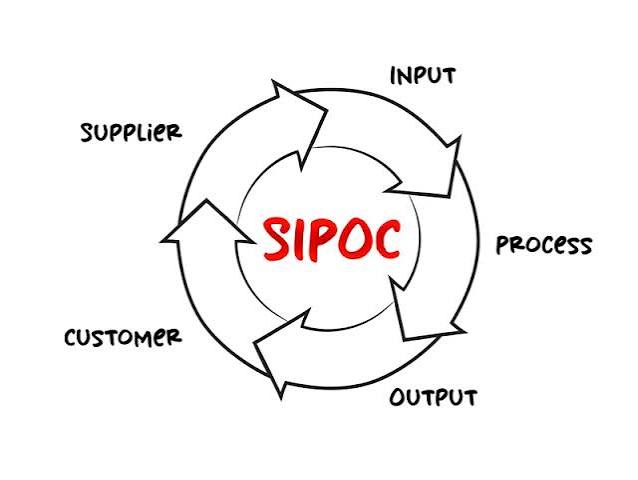
SIPOC represents the five fundamental and crucial elements of a process:
- Suppliers: The people, teams, organisations that provide resources necessary for the process
- Inputs: Materials, information, data, tools, and resources needed to run the process.
- Process: A brief list of high-level steps required to convert input into output
- Outputs: The end products, services, and deliverables created by the process.
- Customers: The internal or external people, teams, or organisations that receive the outputs and benefit from them.
Why Is SIPOC Important for Green Belts?
A Green Belt project requires a defined problem and laid-out process before beginning a detailed analysis. SIPOC enables the building of that foundation for it.
Provides a Starting Point for Further Analysis
SIPOC gives activities like process maps, data analysis, and root-cause analysis a shared picture of the progress. This thus serves as a starting point for the activities to further analyse it.
These analysis procedures can be better understood by joining the Lean Six Sigma Green Belt Course which teaches professionals to carry out process improvement initiatives effectively through waste reduction and the application of Lean tools.
Defines Process Boundaries
One of the most challenging aspects of improvement planning is determining the beginning and the ending of a process. The SIPOC helps develop these boundaries without excessive operational details. This feature helps prevent a scope creep, where a project moves away or expands beyond its original purpose.
Facilitates Team Alignment
Different teams can have different views about the same process. A SIPOC diagram brings those different viewpoints together. This allows the various teams to discuss and agree on definite suppliers, inputs, process, outputs, and customers before proceeding with the project.
Identifies Important Stakeholders
The SIPOC mapping tool makes the process of identifying people and groups connecting to the process a lot easier. This includes not only external customers but also internal teams that can provide inputs or depend on the outputs of the process.
Connects Processes With Customer Needs
One of the most important purposes of process improvement is to create better outputs for customers. When the SIPOC identifies outputs and customers, it helps Green Belt professionals determine whether the process being produced aligns with what the customer truly needs.
How Is a SIPOC Diagram Created?
A Green Belt can follow these steps to create a SIPOC Diagram:
- Define the Process: Understand the process that is being investigated and define its starting and ending points.
- Identify Process Steps: List the major activities that will be involved during the process investigation
- Identify the Outputs: Determine what outputs the process produces; this may include products, services, decisions, or information.
- Identify the Customer: Understand who becomes the receiver or dependant of the process’ output.
- Determine the Inputs: Identify the resources, materials, and data required for the process to operate.
- Identify the Suppliers: Identify who or what provides the inputs
Some processes may require the addition of a ‘Requirement’ to the diagram, which creates a SIPOC-R. They detail crucial specifications that might be required for the inputs or outputs.
When Should Green Belts Use SIPOC?
Green Belts ought to use the SIPOC during the beginning stage of an improvement project, particularly during the ‘Define’ phase of the DMAIC framework. During this phase, teams are still establishing the problem, objectives, stakeholders, scope, and context of the process.
However, the SIPOC can prove to be useful during situations where:
- Process ownership is unclear.
- Multiple teams are involved.
- Transfer of responsibilities between teams creates problems.
- The project scope becomes too broad.
- The process is understood differently by stakeholders.
- The team requires a foundation for detailed process mapping.
While the SIPOC is an excellent tool to help establish the scope of a process, it can be difficult to do so when being applied in a complex process. To address these challenges, professionals should consider the Lean Six Sigma Black Belt Training to learn how to navigate high-stakes businesses by advanced process improvement and use AI to empower their workflows.
What are the Common Mistakes Made When Creating a SIPOC?
Teams can reduce the effectiveness of a SIPOC by making it unnecessarily complicated in the following ways:
- Making the SIPOC too detailed: SIPOC should provide an overall view of a process, not a detailed flowchart
- Ignoring internal customers: Customers are not limited to external stakeholders. Internal departments may also become recipients and dependents of the process outputs.
- Disregarding Stakeholder Inputs: Overlooking the inputs of people who understand the process while developing a SIPOC may result in an incomplete or inaccurate view of the process.
- Confusing inputs with suppliers: Suppliers provide the inputs, whereas inputs are the things that enter the process
- Treating SIPOC as the final analysis: The SIPOC determines the context and scope of a process; it cannot identify the root causes or the features responsible for problems in the process.
Conclusion
A SIPOC may appear to be a simple five-column diagram, but the value it provides is in the clarity. It provides a structured overview of a process before Green Belts start to investigate data and root causes by linking suppliers, inputs, processes, outputs, and customers.
Lean Six Sigma projects are not only about solving the problem correctly but also about solving the right problem. SIPOC helps teams establish the starting point, align stakeholders, define boundaries, and relate process performance to customer needs. It provides the improvement team with a clear picture of the landscape before the deeper analytical work begins.
AI, Plag, Readability



Tab 3
AI Detector-

Plagiarism Checked-